
Source: Shutterstock
The Tradr 2X Long PATH Daily ETF (NASDAQ: PATX) seeks daily investment results, before fees and expenses, corresponding to 200% (2x long) of the daily performance of UiPath Inc. (NYSE: PATH). The ETF is designed to provide traders with amplified exposure to one of the market’s leading enterprise automation and artificial intelligence software companies, particularly within the rapidly expanding robotic process automation (RPA) and AI workflow automation industry.

UiPath develops enterprise automation software that helps organizations automate repetitive digital workflows using robotic process automation, machine learning, and artificial intelligence technologies. The company has become one of the most recognized names in workflow automation, serving enterprises globally across finance, healthcare, manufacturing, technology, and government sectors. As artificial intelligence adoption accelerates worldwide, UiPath has increasingly positioned itself at the intersection of enterprise AI agents, workflow orchestration, and digital transformation infrastructure.
The Tradr 2X Long PATH Daily ETF (PATX) provides leveraged exposure to UiPath shares, amplifying the daily performance of PATH stock. The ETF is highly sensitive to developments such as earnings reports, AI product announcements, enterprise software spending trends, automation adoption rates, macroeconomic conditions, and broader investor sentiment toward growth-oriented software and artificial intelligence stocks.
Unlike diversified ETFs, PATX depends almost entirely on the daily movement of PATH stock and uses derivatives and swap agreements to achieve its 2x leveraged objective. Because leverage resets daily, the ETF is primarily designed for short-term traders looking to capitalize on momentum-driven moves, technical breakouts, earnings reactions, AI-related catalysts, or broader software sector rallies rather than long-term investing.
The ETF has a focused and leveraged objective:
This ETF is not intended for long-term investors. It is a specialized, high-risk trading instrument designed primarily for experienced traders who actively monitor positions and understand the risks associated with leverage, volatility, and daily compounding effects.
Intended Uses
Traders with short-term conviction that PATH stock will rise — driven by improving enterprise software demand, AI automation adoption, earnings beats, margin expansion, or bullish momentum in artificial intelligence infrastructure stocks — may use PATX to amplify potential gains.
The ETF can be used around major catalysts such as quarterly earnings releases, AI product launches, enterprise partnership announcements, automation platform updates, guidance revisions, macroeconomic software sector rallies, or broader technology market momentum shifts.
Active traders may use PATX to gain leveraged exposure to UiPath without directly purchasing additional PATH shares or using margin accounts, enabling participation in momentum-driven software rallies with defined capital deployment.
Key Considerations and Risks
PATX resets leverage daily. Over holding periods longer than one trading day, performance may differ significantly from 2x the cumulative return of PATH stock, especially during volatile or sideways market conditions. Volatility and compounding effects can materially affect long-term returns.
Unlike diversified ETFs, PATX depends entirely on one company. Negative developments such as slowing enterprise spending, disappointing earnings, weaker automation demand, increased competition, or deteriorating guidance could significantly impact performance.
Enterprise software and AI automation stocks remain highly sensitive to macroeconomic conditions, corporate IT spending trends, and investor sentiment toward growth-oriented technology companies.
UiPath operates in a highly competitive enterprise automation market. Failure to maintain innovation leadership, scale AI product adoption, or sustain customer growth could pressure PATH shares materially.
The AI and workflow automation industry is evolving rapidly, with increasing competition from major cloud providers, enterprise software companies, and AI-native startups developing automation platforms and enterprise AI agents.
High-growth software companies are particularly sensitive to rising interest rates and bond yields. Higher rates may compress valuation multiples and reduce investor appetite for speculative technology names.
Leveraged ETFs amplify both gains and losses. PATH itself can experience significant volatility during earnings announcements, macroeconomic data releases, AI-related news events, or software sector rotations, making PATX particularly susceptible to sharp intraday price swings.
Leveraged ETFs may experience wider bid-ask spreads and rapid price fluctuations during volatile sessions. Newer leveraged products may also exhibit lower trading volumes during early adoption phases.
Leveraged ETFs generally carry higher expense ratios because of the operational and derivative costs associated with maintaining leveraged exposure. PATX carries management and financing costs that traders should consider before holding positions over extended periods.
Technical Price Behavior Context
PATX tends to exhibit amplified versions of PATH stock movements:
Because of this, traders often align PATX entries with technical setups in PATH stock, such as:
Community discussions surrounding leveraged single-stock ETFs frequently emphasize how strong trending markets can produce substantial amplified gains, while volatile sideways trading conditions may negatively impact longer-term returns because of daily reset mechanics and compounding effects.
Technical Price Chart
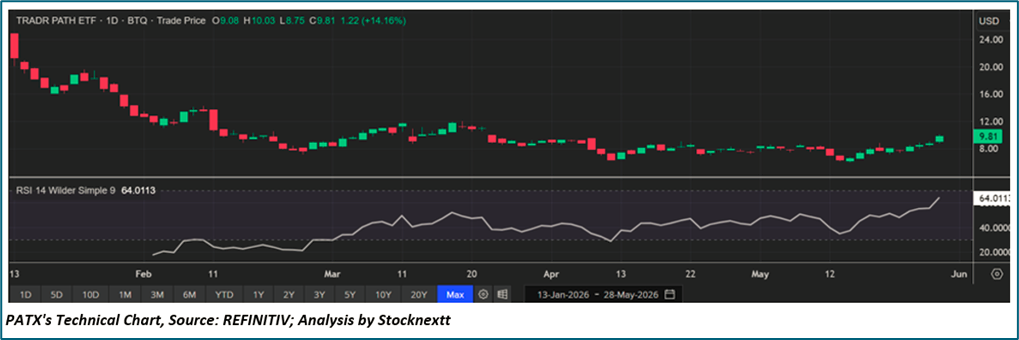

PATX’s price behavior is heavily influenced by the technical structure of PATH shares. Strong momentum breakouts in UiPath can produce rapid upside acceleration in PATX, while failed rallies, earnings disappointments, or risk-off sentiment toward growth stocks can trigger equally sharp pullbacks. Traders frequently monitor volume trends, RSI strength, moving average support zones, and broader artificial intelligence market sentiment when positioning in leveraged enterprise software ETFs.
Conclusion
The Tradr 2X Long PATH Daily ETF (NASDAQ: PATX) is a tactical leveraged instrument designed for traders seeking to capitalize on short-term bullish movements in UiPath stock. By providing 2x daily exposure, the ETF enables amplified participation in periods of strong AI automation momentum, enterprise software rallies, earnings-driven breakouts, and broader technology sector strength.
However, due to daily leverage resets, single-stock concentration, elevated volatility, software sector sensitivity, execution uncertainty, and the rapidly evolving competitive landscape within artificial intelligence and enterprise automation, PATX carries substantial risk and requires disciplined risk management and active monitoring. The ETF is generally more suitable for experienced short-term traders than long-term investors.
Note 1: Past performance is not a reliable indicator of future performance.
Note 2: Reference data for price, technical indicators, support, and resistance levels is as of May 28, 2026 and may be sourced from market data providers such as REFINITIV.
Note 3: Investment decisions should consider an individual’s risk appetite, upside potential, holding period, and prior holdings.
Note 4: Market data may be subject to delays, and information is subject to change without notice.
Disclaimer:
StockNextt having Ontario Business Identification Number 1000958347 and British Columbia registration Number FM1051529 is a trade name under Kalkine Canada Advisory Services Inc., having Business Number 761925130BC0001. The information provided on https://stocknextt.com “Website” is general information only and it does not consider your investment objectives, financial situation and the particular needs of any particular person. You should therefore consider whether the advice is appropriate to your investment objectives, financial situation and needs before acting upon it. You should seek advice from a financial adviser, stockbroker or other professional (including taxation and legal advice) as necessary before acting on any advice. Not all investments are appropriate for all people. The Website is published by StockNextt a trade name under Kalkine Canada Advisory Services Inc. The link to our Terms and Conditions and Privacy Policy has been provided for your reference. On the date of publishing this article/report (mentioned on the website), employees and/or associates of StockNextt or Kalkine do not hold positions in any of the stocks covered on the website. These stocks can change any time and readers of the articles/ reports should not consider these stocks as advice or recommendations later.
